

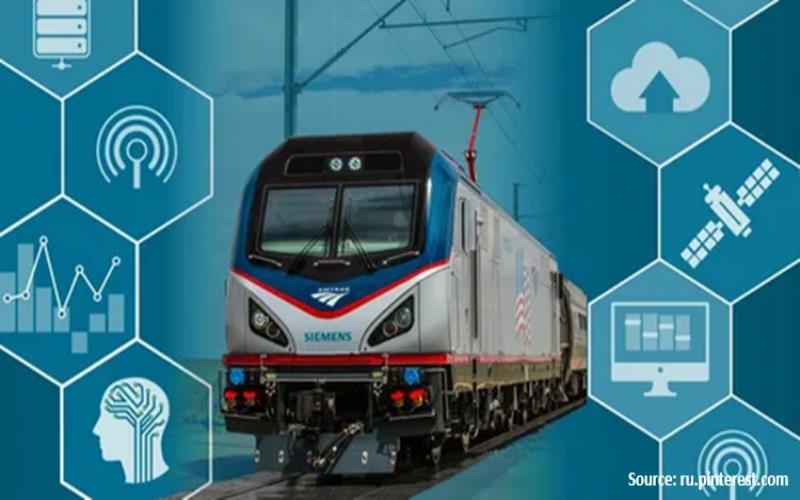
The global railway industry is undergoing a massive transformation with the adoption of digital technologies. The integration of the Internet of Things (IoT) and Artificial Intelligence (AI) in smart railways is enhancing operational efficiency, safety, and passenger experience. These technologies enable real-time monitoring, predictive maintenance, and automation, thereby reducing costs and improving reliability.
The blog explores the latest advancements in AI and IoT integration in smart railways, covering predictive maintenance for rolling stock to enhance safety and reduce derailments. It discusses how AI-powered smart trains improve efficiency in extreme weather conditions and how AI and IoT integration strengthens train security by preventing crimes like theft. Moreover, the blog highlights government investments and green initiatives driving smart railway development. Additionally, it delves into recent innovations such as predictive maintenance using IoT sensors, AI-driven passenger services, and intelligent parcel management. Furthermore, the blog sheds light on future opportunities, including Quantum AI for railway network optimization and AI-powered Hyperloop transport systems, shaping the next generation of railway technology.
The Role of AI and IoT in Advancing Smart Railways
1. Predictive Maintenance for Rolling Stock Using IoT and AI
IoT and AI are transforming railway maintenance by enabling real-time monitoring and early fault detection in tracks and rolling stock. These technologies help prevent failures, reducing costly repairs and service disruptions. According, to the Federal Railroad Administration, 2024, the U.S. recorded 1,164 train derailments in 2023, averaging nearly three per day. Predictive maintenance can significantly lower these risks by identifying track wear and scheduling timely repairs. By leveraging AI and IoT for predictive maintenance, rail operators can drastically improve safety, reduce operational costs, and ensure a smoother, more efficient railway system for the future.
2. Smart Trains: Ensuring Efficiency in Extreme Weather with AI and IoT
Harsh weather conditions often disrupt traditional rail operations, leading to delays and safety risks. However, smart trains equipped with Artificial Intelligence (AI) and Internet of Things (IoT) can efficiently adapt to extreme weather by leveraging real-time monitoring, predictive analytics, and automated response systems. These technologies help optimize speed, adjust braking, and detect track conditions, ensuring smooth and safe travel. For instance, in July 2024, bad weather and floods significantly impacted train operations in Germany, causing only 45% of long-distance trains to reach their destinations on time. This highlights the urgent need for AI-powered predictive maintenance and IoT-driven weather monitoring, which can help mitigate disruptions and improve punctuality. By integrating AI and IoT, smart trains not only enhance operational efficiency but also provide a resilient transport system capable of withstanding extreme weather challenges.
3. Enhancing Train Security with AI and IoT Integration
Crime on trains, including theft and robbery, has been rising, posing serious safety concerns for passengers and cargo. By integrating AI and IoT, smart trains can significantly reduce these incidents through real-time surveillance, predictive threat detection, and automated security alerts. AI-powered facial recognition can identify suspicious activities, while IoT-connected sensors and smart cameras provide continuous monitoring, enabling instant responses to potential threats. As per reports published by the Association of American Railroads, 2024, over 65,000 thefts occurred in trains, marking a nearly 40% rise from the previous year. This surge underscores the urgency of deploying advanced security technologies to safeguard passengers and cargo. With AI-driven analytics and IoT-enabled security systems, smart trains can create a safer travel environment, ensuring protection against crimes while boosting passenger confidence in railway transport.
4. Government Support and Investment Driving Smart Railways Growth
Governments are heavily investing in sustainable infrastructure, making smart railways a key priority. These systems integrate energy-efficient technologies and digital solutions to enhance efficiency and reduce carbon emissions. As per reports published by the World Bank Group, 2023, green bonds have raised $2.5 trillion globally to support green and sustainable projects, accelerating the shift towards intelligent railway networks. Strong government backing is accelerating the transformation of railway transportation, making it more sustainable and efficient.
Major Innovations Transforming the Railway Industry
-
Predictive Maintenance
IoT sensors are now extensively deployed on critical train components such as brakes, wheelsets, and engines, as well as along tracks. These sensors monitor real-time conditions, enabling predictive maintenance that reduces unexpected downtimes and enhances reliability. Countries like Japan, Germany, France, and the UK are setting new industry standards through continuous advancements in edge computing, AI, and IoT. For instance, in Oct 2024, Japan’s Shinkansen bullet trains utilize IoT for predictive maintenance, minimizing delays and ensuring smoother operations. Similarly, Deutsche Bahn in Germany has implemented IoT sensors to monitor track and train conditions in real time, improving punctuality and reducing accident risks. These advancements highlight how IoT is revolutionizing railway operations by enhancing efficiency and safety.
-
Enhanced Passenger Services
The integration of IoT and AI is improving passenger experiences through smart ticketing systems and personalized services. Sensor-based systems can detect passengers via smartphone apps as they enter stations or trains, automatically charging the correct fare and streamlining the boarding process. According to recent reports published by Hitachi Rail Limited, Hitachi’s 360Pass mobile app enhances smart railway systems by integrating multiple modes of transport, allowing passengers to seamlessly plan and pay for their journeys with greater convenience and efficiency. These advancements are making railway travel more seamless, efficient, and passenger-friendly, setting new standards for modern transportation.
-
Intelligent Parcel Management
AI and IoT are also revolutionizing cargo services. Researchers have developed intelligent parcel management systems that utilize IoT devices and machine learning to scan, sort, and monitor parcels efficiently, enhancing security and operational efficiency. The logistics and transportation sectors are among the biggest playing fields for cutting-edge technologies, with more than 95% of all manufactured goods moved by container at some point during their shipping lifecycle. According to recent reports published by IBM, by using IoT sensors and blockchain, IBM enables tamper-proof data recording, allowing stakeholders to track cargo conditions, temperature, and location with greater accuracy. This innovation enhances efficiency, minimizes losses, and builds trust in global logistics.
Emerging Opportunities in AI and IoT for Railways
-
Quantum AI for Railway Network Optimization
With the rise of quantum computing, AI-driven railway systems could harness quantum algorithms to solve complex optimization problems instantly. This could lead to revolutionary improvements in scheduling, predictive maintenance, energy distribution, and infrastructure planning, making railway operations more responsive and efficient than ever before.
-
Hyperloop and AI-Driven Ultra-Fast Rail Transport
As futuristic transport systems like Hyperloop evolve, AI and IoT will play a crucial role in optimizing vacuum tube pressure, real-time route adjustments, and predictive maintenance of pods and tracks. AI-driven monitoring will ensure smooth, energy-efficient, and ultra-fast rail transport solutions.
Conclusion
The integration of IoT and AI in smart railways is transforming the industry by improving safety, efficiency, and passenger experience. Predictive maintenance is reducing derailments and service disruptions through real-time monitoring and early fault detection. AI-driven systems ensure seamless train operations, even in extreme weather conditions, while smart security solutions help prevent crimes like theft and robbery. Governments worldwide are supporting sustainable railway development with major investments in green infrastructure, accelerating the adoption of energy-efficient and eco-friendly transport solutions.
Additionally, digital advancements in ticketing, cargo monitoring, and intelligent transport management are streamlining operations and enhancing service quality. Looking ahead, innovations such as Quantum AI and AI-driven high-speed transport systems will further revolutionize railway networks, making them more reliable, efficient, and future-ready. The adoption of IoT and AI in smart railways is revolutionizing the industry by enhancing safety, efficiency, sustainability, and passenger convenience, paving the way for a more connected and intelligent transportation system.
ABOUT THE AUTHOR
Rudra Choudhury is a passionate and highly enthusiastic researcher with over four years of experience. He is dedicated to assisting clients in overcoming challenging business obstacles by providing actionable insights through exhaustive research. Rudra has a keen interest in various industries, including ICT & Media and Agriculture. He consistently endeavours to deliver valuable perspectives in these areas. In addition to his research work, Rudra enjoys sharing his thoughts and ideas through articles and blogs. During his leisure time, he finds solace in the world of literature and art, often engrossed in reading and expressing his creativity through painting. The author can be reached at [email protected]
