

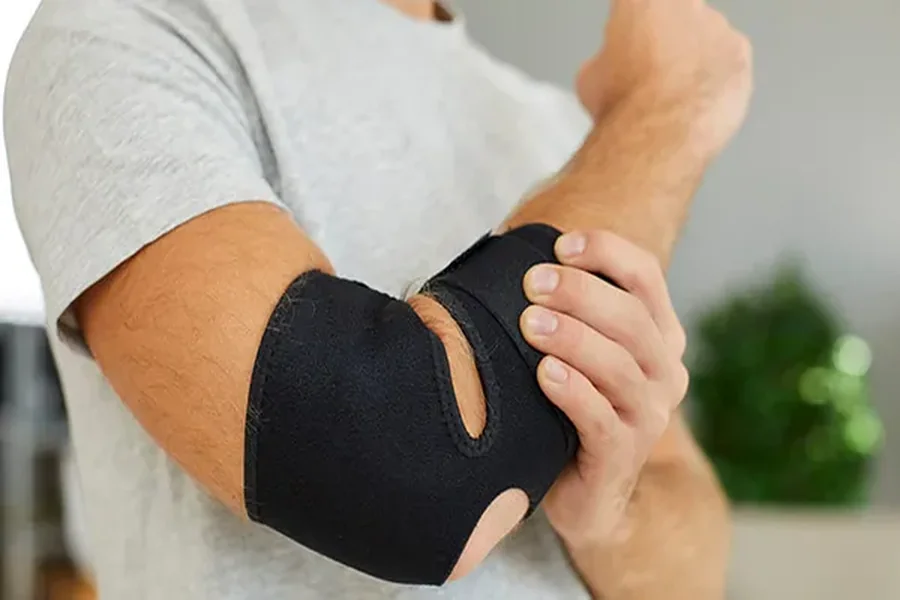
You can see athletes wearing different kinds of elbow support in gyms, on tennis courts, and on training fields. These recovery aids, like compression sleeves and special straps like a tennis elbow support band, have become a normal part of sports culture. But the real question is: Do supports for sports recovery really work?
This guide goes over the science, benefits, and limits of elbow supports so you can make an informed choice. It covers everything from lifting heavy weights and thinking about getting an elbow support for the gym to dealing with chronic elbow pain and trying to avoid injury.
What are the supports for sports recovery?
Wearable sports recovery supports are made to:
- Keep joints stable
- Take the strain off of muscles and tendons
- Make blood flow better
- Give compression
- Improve your proprioception (joint awareness)
Some common types of the elbow are:
- Sleeves for compression
- Support bands for tennis elbow
- Braces for the elbow that can be changed
- Supports that are stiff or hinged (for very bad injuries)
Each one has a slightly different use depending on the activity and the condition.
Why the Elbow Is So Weak in Sports
The elbow joint can handle stress that happens over and over again in activities like:
- Lifting weights
- Baseball, CrossFit, tennis, golf, and bodyweight training are all sports
Lateral epicondylitis (tennis elbow) and medial epicondylitis (golfer’s elbow) are two common types of overuse injuries. These conditions happen when tendons get irritated from gripping, lifting, or extending the wrist over and over again.
This is where things like elbow support products come in.
Does using an elbow support at the gym help you do better?
A lot of people who go to the gym wear elbow supports while they work out, especially during:
- Press on the bench
- Press from above
- Crushers for the skull
- Pull-ups
- Dips
Possible Benefits:
Better Joint Stability
Under load, compression and light bracing can help keep the elbow stable, especially during heavy compound lifts.
Enhanced proprioception
Putting on a sleeve gives you more sensory feedback, which helps you stay more aware and in control while you move.
Circulation and warmth
Compression supports blood flow and keeps the joint warm, which may help with stiffness.
Less Pain That You Feel
Some athletes say that using an elbow support makes lifting less painful.
But it’s important to know that elbow supports don’t make you stronger. They might make you feel more confident and comfortable, but they won’t replace good technique or progressive programming.
How does the Tennis Elbow Support Band work?
A full sleeve is not the same as a tennis elbow band. It is a strap that goes around the forearm just below the elbow joint.
How it works:
- It moves the force away from the tendon that is hurting.
- It lessens the stress at the point where the tendon attaches.
- It makes gripping or lifting less painful.
These straps can help with pain in the short term, especially when you’re active. As part of conservative treatment for tennis elbow, they are often suggested.
But here’s the important part: they help with the symptoms but don’t fix the underlying tendon problem.
When Elbow Support Really Helps
When are elbow supports most helpful?
- You have mild to moderate tendon pain
- You’re getting back into sports after an injury
- You need pain relief during activity for a short time
- You want extra support during hard workouts
They can be very helpful during rehabilitation phases when you need to slowly add weight.
When Elbow Support Doesn’t Work
Elbow supports are not meant to be used instead of:
- Training the muscles in your forearms to be stronger
- Work on mobility
- Managing loads
- The right way to lift
- Physical therapy (when necessary)
If the pain lasts for weeks or gets worse, just wearing an elbow support won’t help. Progressive strengthening, especially eccentric loading exercises, is needed for chronic tendon injuries.
If you use braces too much, they may also make your muscles less active over time.
Which is better: a compression sleeve or a tennis elbow band?
It all depends on what you want to do.
Sleeve for Compression
Best for:
- Support for all joints
- Working out at the gym
- A little stiff
- Circulation and warmth
Support Band for Tennis Elbow
Best for:
- Pain in specific tendons
- Irritation on the outside of the elbow
- Pain in the grip
If you’re not sure, start by figuring out what your symptoms are. Compression may help diffuse soreness, but a strap may help pinpoint tendon pain more.
Do they help you get better faster?
The proof shows:
- They can help with pain while doing things.
- They might make things more comfortable.
- They can help with the early stages of rehab.
But how fast you get better depends mostly on:
- Managing the load
- Correctly strengthening
- Enough sleep
- Sleep and food
Supports are not a cure; they are an addition.
The Hidden Factor: Psychological Benefits
Interestingly, part of the benefit may be mental.
An elbow support can do the following:
- Boost confidence
- Make people less afraid of getting hurt again
- Make people think things are more stable
What an athlete believes can affect how well they do and how quickly they recover. If a support makes you feel safe while you recover properly, it can help you get back to sports in an indirect way.
Risks of Using Too Much
Even though it’s usually safe, using it wrong or too much can:
- Make people dependent
- Masking symptoms that are getting worse
- Put off getting the right care
- If it’s too tight, limit circulation
Make sure of the following:
- Fit correctly
- Correct placement
- Comfortable compression
Take off the support when you don’t need it to keep your muscles working naturally.
How to Use an Elbow Support the Right Way?
If you decide to use elbow support:
- Only use it when you’re doing something that puts a lot of stress on your body or hurts.
- Use it with a program that makes you stronger.
- Don’t wear it all day if you don’t have to.
- Get new supports if the old ones are worn out.
- If the pain lasts longer than 4–6 weeks, see a doctor.
Who Should Think About Elbow Support?
You might benefit if you:
- Lift weights on a regular basis.
- Play sports with racquets.
- Do the same gripping tasks over and over.
- Are getting better after a minor elbow injury.
- Sometimes feel pain in your elbow while working out.
Supports can be used in a smart way by both experienced and new athletes.
Elbow Support for Gym and Sports: Do They Help?
Yes, but not too much.
Elbow support items, like a gym elbow support or a tennis elbow support band can:
- Make you feel better
- Boost your confidence
- Give you mild support
- Help with recovery
But they are not magic fixes.
For long-term elbow health, you need to:
- Smart coding
- Slowly getting better
- Building up the muscles in the upper arm and forearm
- Talking about how to move and how to do things
Don’t think of elbow support as a way to get better permanently.
Final Thoughts
Don’t ignore your elbow pain, but don’t freak out either. Most elbow problems get better with the right amount of load management and strengthening.
Use elbow support in a smart way. Train smart. Get to the bottom of it.
And don’t forget: the goal isn’t just to stop the pain, it’s to make your joints strong for a long time.
